



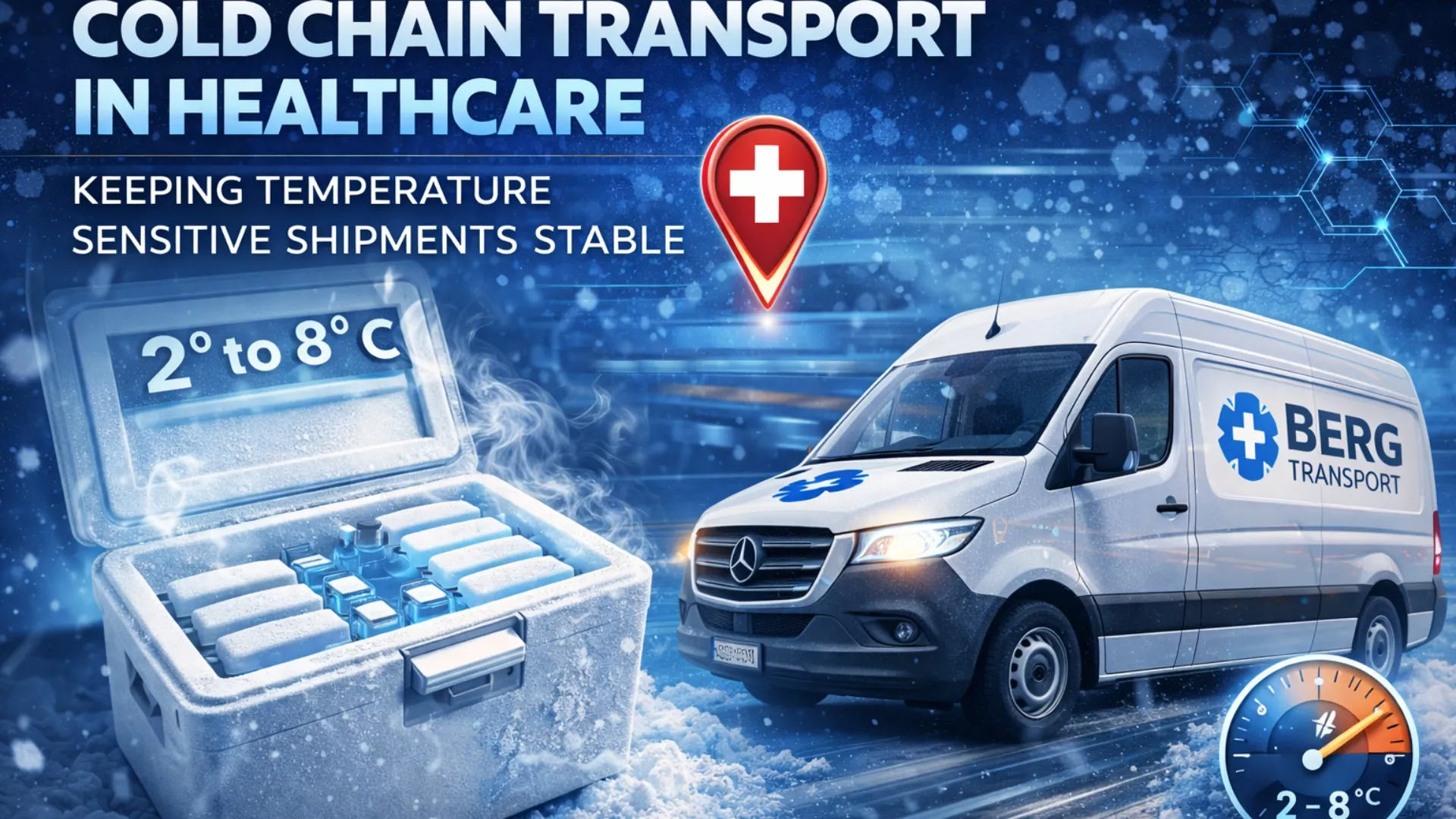
Cold chain handling in healthcare is sensitive because many products and materials must travel within defined temperature ranges. At the same time, real operations are pragmatic. Not every shipment requires an actively refrigerated vehicle. For many short to mid distance transports, a passive cooling solution using an insulated box and suitable cooling elements can be a practical option when planning is clean and execution is disciplined. The key is not only the box. The key is the full chain of preparation, transit time, direct delivery, and fast handover.
In Switzerland, medical transports often cross cantonal borders, yet many trips remain clearly bounded in time. That is where passive solutions can perform well. They are flexible, economical, and suitable for defined routes. However, expectations must remain realistic. Passive cooling is not an unlimited solution for long and unpredictable chains. It is a reliable method when time windows, routing, and handover are aligned.
Why temperature control matters in healthcare logistics
In medical operations, temperature can be a quality requirement. Certain medicines, diagnostic materials, and some samples can be sensitive to deviation. Many organizations therefore use clear requirements, often in a 2 to 8 degree range. In practice, a stable process chain makes those requirements easier to meet realistically. When pickup, transit, and acceptance are coordinated, temperature control remains manageable. When delays, detours, or long waiting times occur, the chain is placed under unnecessary strain.
Temperature control is therefore not only about maximum technology. It is about suitable organization. Packaging, time, and discipline work together. The best cold chain approach is the one that fits the use case and is applied consistently.
What passive cooling means in practice
Passive cooling does not rely on active vehicle refrigeration. It relies on an insulated transport container that stabilizes the internal environment through insulation materials and cooling elements. Common components include:
- Insulated box with suitable insulation performance and size
- Cooling elements in the right type and quantity
- Inner packaging to protect and stabilize the shipment
- Clear labeling so handling and priority are unambiguous
This method is especially suitable when transit times are controlled and routes remain disciplined. It also aligns well with direct trips and same day logic because short timelines and fast handovers support stability.
2 to 8 degrees in real operations: what truly drives results
Many organizations cite 2 to 8 degrees as the standard range. Whether that range remains stable depends on multiple factors beyond the box itself. Key drivers include:
- Preparation of the cooling elements and the box before pickup
- Loading and placement so cooling works effectively
- Transit time because each minute increases demands
- Outside temperature which can vary seasonally
- Stops and waiting time which should be minimized
From a logistics perspective, the principle is short and direct. The fewer detours and the less waiting time, the more stable a passive setup remains. Delays often occur not on the road, but at interfaces: pickup is late, the recipient is unreachable, or the receiving point is unclear. That is why handover planning is part of cold chain quality.
Direct delivery and time discipline as the foundation
Passive cooling is process dependent. Direct delivery reduces handling steps and prevents the shipment from staying in transit longer than necessary. Time discipline in this context means pickup within the agreed window, a direct route without extra stops, and a handover without waiting. These elements are connected. When a passive solution is used for 2 to 8 degree shipments, the workflow should intentionally avoid unnecessary complexity.
- pickup within the agreed time window
- direct route with minimal intermediate stops
- clearly defined receiving point at destination
- handover to a defined person or receiving desk
In practice, the handover is part of the cold chain. If a courier must wait at destination, the passive setup is under more strain. It is therefore beneficial to clarify reception timing and responsibility in advance.
Common use cases in Switzerland
Across Switzerland, there are many situations where passive cooling can be practical. The most common are defined routes with clear time windows where a fast direct trip is realistic. Examples include:
- Pharmacy to clinic for same day medicine delivery within a defined timeline
- Practice to laboratory with routine pickup windows for diagnostic materials
- Laboratory to partner site within agreed time windows
- Scheduled special trips with appointment acceptance and coordinated handover
Realistic scoping remains important. Passive cooling is a strong option when the mission profile fits. For very long, unpredictable routes or high delay risk chains, requirements increase and the concept must be chosen carefully.
Handover routines: the bottleneck of many cold chain shipments
Many delays happen at destination. Reception is closed, the receiving desk is unclear, the responsible person is not reachable, or access is complex. For cold chain shipments, the handover should be defined in advance. Four questions help:
- Who will receive the shipment
- Where the handover takes place
- When the acceptance window is
- Which local rules apply
When these points are clear, waiting time drops and the shipment moves faster into the next process step. This reduces stress and supports temperature stability.
Regular routes and same day: two operating models
Passive cooling box transports can work well in two models. First, regular routes for predictable flows. Second, same day direct trips for urgent demand. The right choice depends on whether the flow is recurring or ad hoc. Many organizations combine both: routine windows for stable flows and direct trips for critical exceptions. This combination is often the most efficient because it balances stability with responsiveness.
Practical recommendations for senders
- Preparation: condition cooling elements, have the box ready, label the shipment clearly.
- Time windows: plan pickup and delivery to minimize waiting.
- Direct trips: avoid unnecessary stops for 2 to 8 degree shipments.
- Handover: define the receiving point and responsible person in advance.
- Site notes: share access, parking, internal paths, and security guidance.
These steps are simple, yet they often decide outcomes. Passive cooling works reliably when it is treated as a process, not only as a container.
Conclusion
Passive cooling solutions are a practical option in healthcare for defined 2 to 8 degree use cases when the process chain is aligned. The key success factors are direct delivery, time discipline, defined handover routines, and reliable communication. When these elements work together, many medical transports in Switzerland can be handled efficiently and realistically, without overstated claims and without unnecessary complexity.
Berg Transport supports healthcare organizations across Switzerland with planned and express capable transports and passive cooling box support for defined missions. The focus is direct routing, clean handovers, and a pragmatic setup that works reliably in daily operations.