



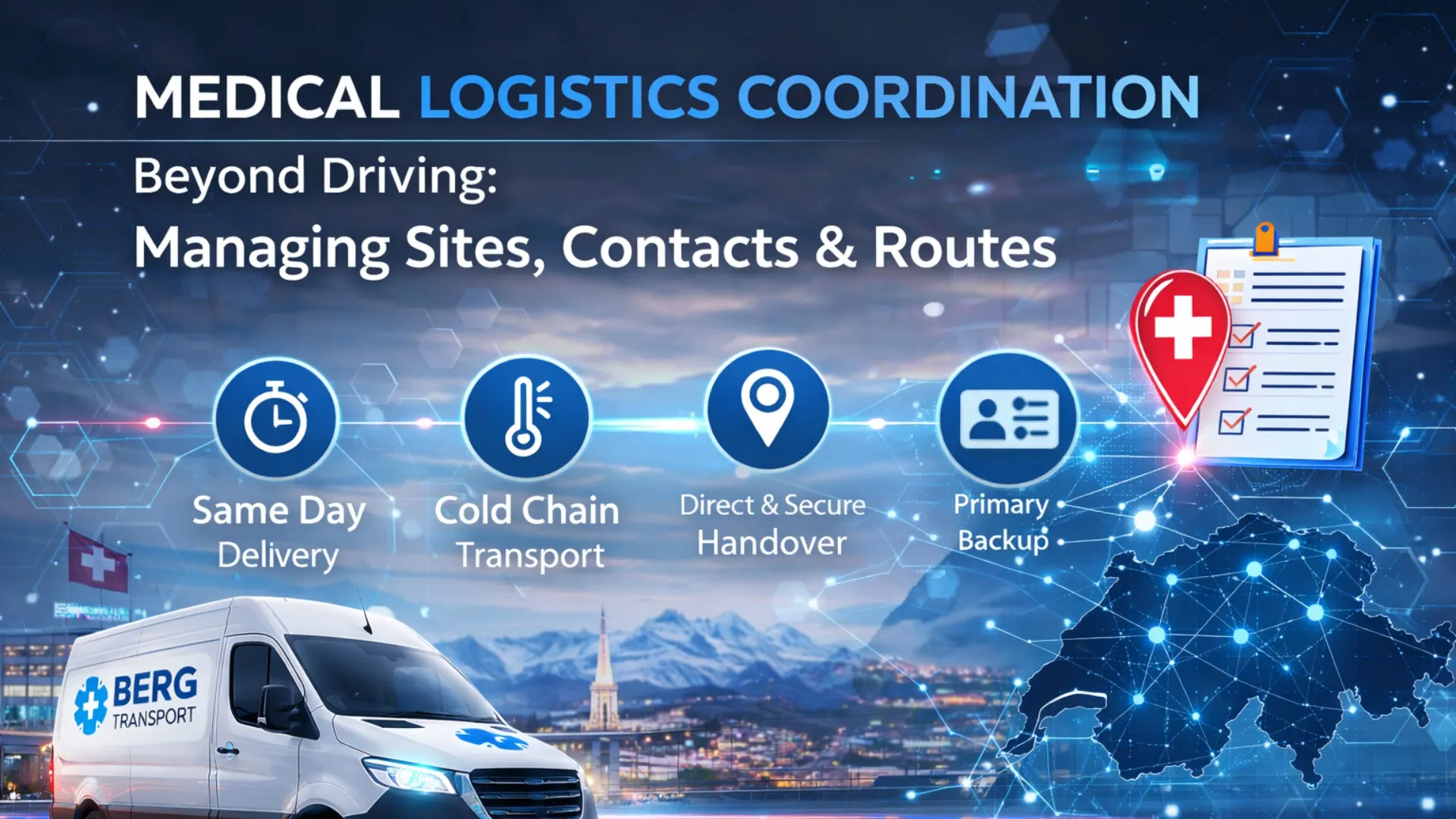
Medical transport works through more than driving. It works through coordination. When multiple sites, different contacts, and various time windows are involved, logistics becomes an operational system. Many organizations see the same pattern. The trip itself is rarely the bottleneck. The bottleneck is missing information, unclear responsibility, or exceptions that disrupt the daily plan. This is where medical logistics coordination matters. It combines transport with operational management so workflows remain predictable and internal teams are relieved.
In Switzerland, healthcare logistics is often organized across cantons and across networks. Laboratories serve multiple senders, clinics cooperate within groups, pharmacies supply different facilities. This creates recurring flows and short notice changes. Coordination in this context means clean prioritization, sensible route planning, defined contact chains, and clear rules for deviations. When these foundations exist, operations become calmer and quality improves without overstated technical claims.
What medical logistics coordination means
Medical logistics coordination is the operational control of transports and handovers in healthcare environments. It includes planning, dispatch, communication, and exception handling. The core idea is that transports are not isolated tasks. They are part of a process network. Coordination creates reliability by organizing interfaces.
Typical responsibilities include:
- prioritizing transports by urgency and time window
- planning regular routes and complementing them with express direct trips
- defining contact chains per site
- clarifying access and receiving points
- status communication along the mission
- escalation rules for deviations
Coordination is therefore not an add on. It is the structure that prevents every transport topic from becoming a new individual project.
Why coordination saves time in daily operations
Without coordination, many small questions arise: where is the correct entrance, who receives, when is acceptance possible, what happens if nobody is reachable. Each question consumes time on both sides. Over a day, this creates a real workload, especially in laboratories, clinics, and pharmacies that operate on tight schedules.
Coordination saves time because it establishes standards. Once site details are captured, they do not need to be re discovered. Once contact chains exist, deliveries do not depend on one person. Once escalation rules are clear, decisions become calm instead of rushed. The result is fewer operational interruptions and a smoother daily workflow.
Prioritization: the heart of operational management
In healthcare logistics, there is rarely only one priority. There is urgent, important, and routine. Without prioritization, conflicts appear: an express trip collides with a route, or an appointment delivery is forced into a multi stop chain. Coordination means making priorities explicit and selecting the right operating mode.
- Routine: regular pickup and delivery routes with stable windows.
- Appointment: scheduled special missions with direct routing and defined handover.
- Urgent: same day express direct trips when time critical demand is high.
When these categories are applied consistently, the system becomes more efficient. Routine stays stable. Appointments stay predictable. Urgent demand is served quickly without destabilizing everything else.
Route optimization: pragmatic instead of theoretical
Route optimization often sounds like complex software. In practice, it is usually pragmatic decisions: the order of stops, buffer time, and deciding which missions should run direct. The best route is not the shortest mathematically. It is the one that remains reliable in real world conditions.
Pragmatic optimization considers:
- typical traffic windows
- site constraints such as access, parking, and internal walking distance
- acceptance hours and slots
- criticality of specific stops
A key rule is to avoid placing critical narrow window stops at the end of a long chain. Coordination keeps sequencing realistic and stable.
Contact chains: small structure, large impact
Many delays happen because a single person is unreachable. A simple contact chain per site solves this. Instead of one name, you need a primary and a backup contact. A defined receiving point also helps. This allows a courier to hand over even when the primary contact is temporarily unavailable.
A contact chain typically includes:
- primary contact with direct number
- backup contact with direct number
- defined receiving point or desk
- notes on receiving hours and access
This structure reduces waiting, follow up calls, and escalations significantly.
Escalation rules: what happens when something deviates
Deviations happen. Traffic, last minute changes, unreachable recipients. The difference between chaos and stability is whether clear rules exist. Escalation rules answer questions such as who to contact first, how long to wait, which alternatives are allowed, and when to inform the sender. Without rules, every deviation becomes an ad hoc decision.
Pragmatic escalation rules are short and clear. They must fit real operations and should be aligned with clients in advance. This keeps deviations controlled.
Handover routines: coordination does not end at the door
Handover is the moment responsibility shifts. In healthcare logistics it should be clearly defined. Coordination ensures that receiving points are known per site and avoids ambiguous drop off unless a site explicitly allows it. Defined handover reduces follow up and protects process quality.
When passive cooling boxes are used, fast handovers become even more important. Long waiting time places the setup under strain. Coordination therefore aligns reception and time windows to allow handover without delay.
How clients benefit from coordination
Coordination relieves internal teams. Instead of supporting every transport manually, clients can rely on standards. This creates operational space. It also increases transparency because status updates become predictable and escalations follow clear rules.
Typical benefits include:
- fewer operational questions during the day
- higher punctuality through stable planning
- less waiting time at sites
- clear responsibility at handover
- better balance of routine routes and express trips
Checklist for a coordination ready setup
- Site data: entrance, receiving point, access, parking, internal paths.
- Contact chain: primary and backup contact per site.
- Time windows: realistic pickup and delivery slots.
- Priorities: clearly categorize routine, appointment, urgent.
- Escalation: short rules for deviations.
- Handover: defined receiving point and acceptance process.
When these points are in place, logistics stops being daily firefighting and becomes a stable process.
Conclusion
Medical logistics coordination is operational management that truly reduces workload. It makes transports predictable, reduces follow up, and stabilizes handovers. In Switzerland, where healthcare logistics is often multi site and cross canton, coordination is a critical lever for quality and efficiency. Through clear prioritization, pragmatic route optimization, contact chains, and escalation rules, the system runs routine flows efficiently and handles exceptions in a controlled way.
Berg Transport supports healthcare organizations across Switzerland with logistics coordination and operational management: route planning, prioritization, clean handover routines, and fast direct trips when needed. The focus is pragmatic execution, predictable workflows, and reliable communication.