



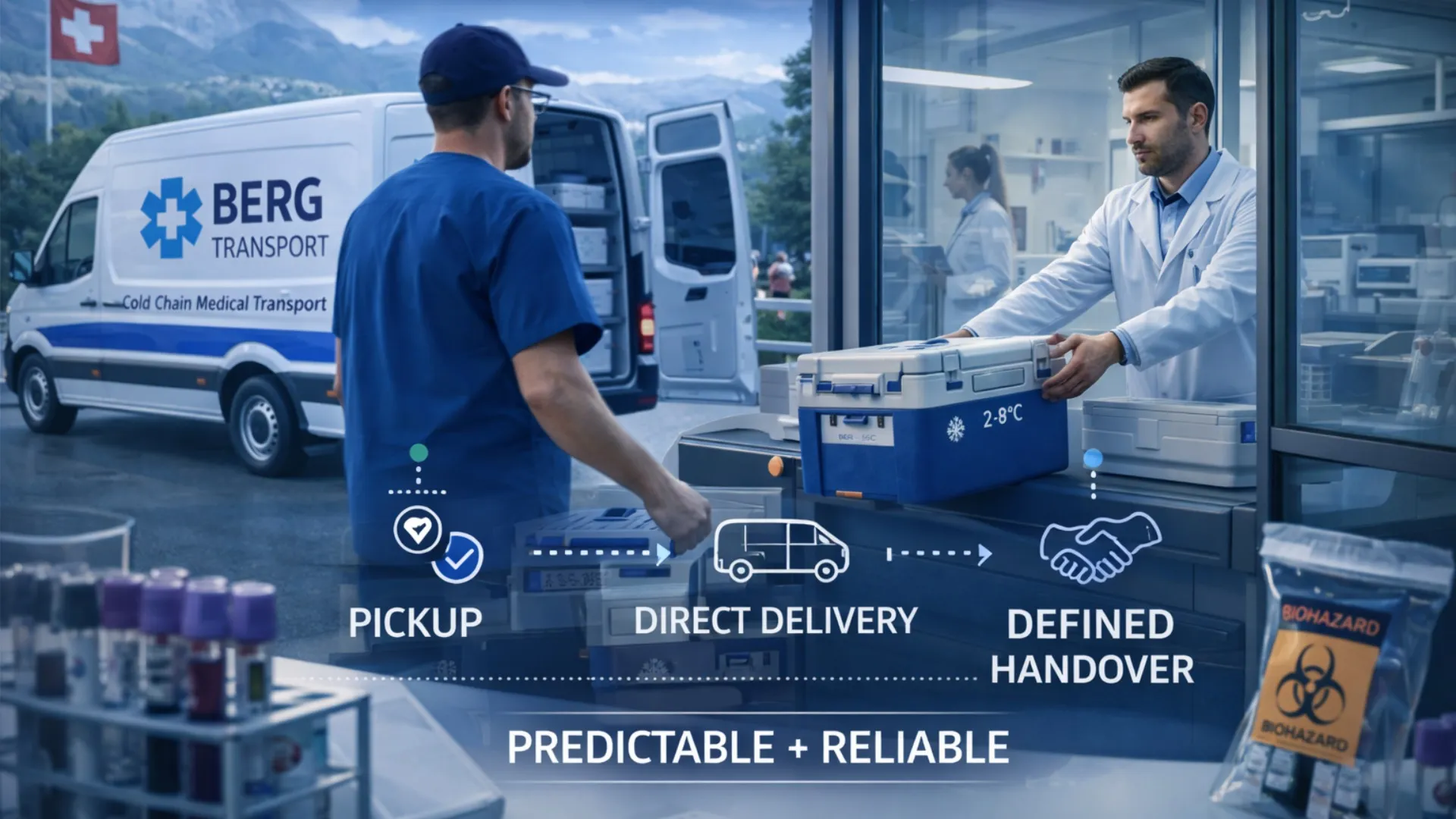
Lab samples are a core component of modern medical workflows. Between collection, transport, and analysis there are often defined time windows, and any delay can trigger follow up or downstream rescheduling. At the same time, laboratories in Switzerland frequently operate across regions. Practices, clinics, pharmacies, and external collection sites must be connected reliably so sample flows remain stable in daily operations. This is where transport becomes a process: pickup, direct delivery or routinized routing, and acceptance that happens without disruption.
A common misconception is that lab sample transport is mainly about speed. In practice, predictability matters more: a reliable pickup window, clear contact points, and a handover routine that does not need improvisation. When these elements are executed consistently, the sample moves from the collection site to lab intake without operational friction and can enter the intended workflow.
Why lab sample transport is highly process dependent
Laboratory workflows are scheduled. Intake, registration, pre processing, and analysis follow internal steps and capacities. That makes timing critical. If samples arrive too late, an analysis window can shift. If samples arrive too early, intake can still be blocked if a lab accepts only within certain slots. Transport is therefore always time window management.
Risk also concentrates at interfaces: unclear receiving points, unreachable contacts, or missing site information. Many delays happen not on the road but at the door. That is why sample transport should be understood as a chain of pickup, routing, handover, and confirmed acceptance.
Pickup windows: more stable than exact minutes
For practices and collection sites, predictable pickup is essential. A pickup window is usually more practical than a single minute. It allows buffer for real conditions while staying precise enough to support daily operations. The window must align with internal routines. If a practice organizes collections in batches, pickup should be timed so preparation and handover can happen without rush.
A well defined pickup window includes:
- a clear time range rather than a single minute
- a defined handover point inside the practice
- primary contact and backup contact
- access, parking, and internal path notes
These basics reduce waiting and prevent samples from sitting unnecessarily in reception areas.
Direct delivery: when it is the right choice
Direct delivery is especially useful when time windows are tight or when a sample must enter lab intake quickly. Every additional interface increases the chance of delay or mix up. A direct trip reduces handling and stabilizes ETA. This is not only faster. It is more controlled.
Direct delivery is commonly used for:
- time critical samples or urgent analysis needs
- pickups outside the regular route schedule
- destinations with narrow intake slots
- situations where intermediate stops should be avoided
In practice, direct delivery is often a complement. Routine flows run on fixed routes. Critical exceptions run as direct express trips. This keeps the overall system stable.
Regular routes: the backbone of recurring sample flows
For many laboratories, regular pickup routes are the backbone. They connect multiple collection points to lab intake. The benefit is standardization. Contacts become familiar, handovers follow the same logic, and time windows become reliable. This reduces coordination work on both sides.
A stable route should be planned so critical stops are not placed at the end of a long chain when their windows are narrow. Buffer time and realistic sequencing matter. A route is good when it does not require constant daily adjustment.
Handover and acceptance: no grey zones
Lab samples should not disappear into ambiguous drop off points. Handover means a defined person or intake desk accepts the shipment. This reduces follow up and helps samples move into lab processing quickly. Four questions are essential:
- Who receives, including a backup
- Where the intake point is, including the correct entrance
- When acceptance is possible
- Which local rules apply
When these questions are answered, waiting time drops and operational phone calls decrease. Documentation becomes easier for both sides.
Coordination across multiple sites
Many laboratories operate within networks of practices, satellite sites, and partners. Coordination becomes essential. It is not overhead. It is standardization. Site profiles, contact chains, pickup windows, and escalation rules create a system that does not require daily firefighting.
A pragmatic coordination model includes:
- clear prioritization: routine vs urgent
- fixed pickup windows per site
- contact chains with backup
- escalation rules for deviations
- short status updates through the mission
With this structure, sample flows remain stable even when the healthcare day changes quickly.
Practical tips for practices and collection sites
- Handover point: define a fixed location inside the practice.
- Preparation: have samples and documents ready in time.
- Contacts: primary and backup with direct numbers.
- Access: communicate parking and the correct entrance.
- Timing: select a pickup window that fits internal routines.
These steps minimize delay and prevent pickups from becoming a burden on daily practice operations.
Practical tips for laboratories
- Intake windows: communicate clearly when intake is possible.
- Receiving point: use a defined desk instead of shifting responsibility.
- Route logic: schedule critical stops early or with buffer.
- Exceptions: define express direct trips as a complement.
- Site profiles: document recurring site details.
When the lab side and the pickup side share the same process logic, sample flows become calmer and measurably more reliable.
Conclusion
Lab sample transport in Switzerland becomes reliable when pickup windows, direct delivery, handovers, and coordination are treated as one system. Predictable routes and clear intake routines reduce disruptions and follow up. Direct express trips complement routine without destabilizing the overall operation. This moves samples from collection to lab intake with minimal friction so they can enter the intended analysis workflow.
Berg Transport supports practices, clinics, and laboratories across Switzerland with regular pickup routes, direct express delivery, and clean handover routines. The focus is predictable time windows, defined contact chains, and execution that works in real healthcare operations.